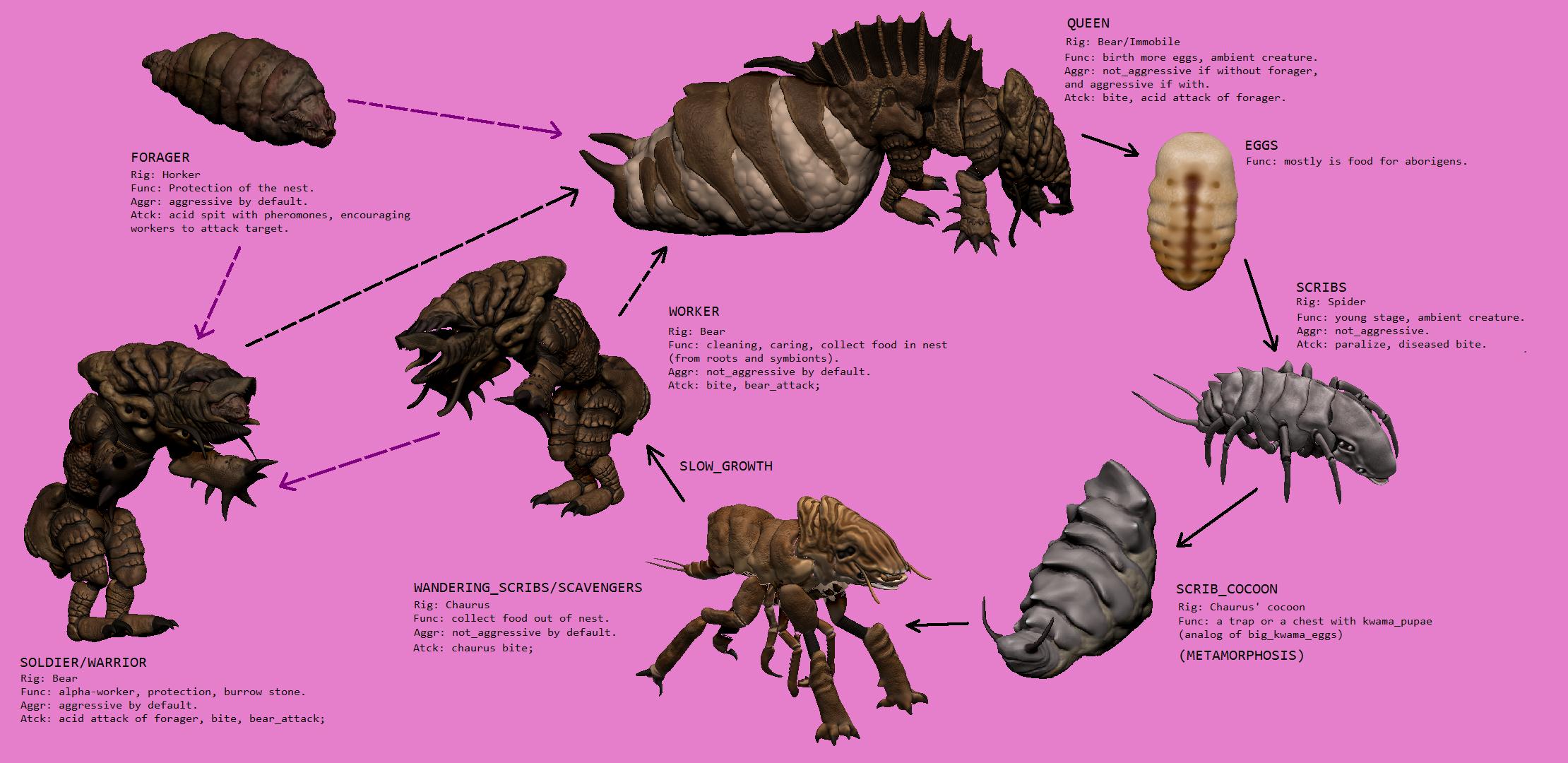
Few things can make a game more immersive than intricate attention to ecology. The kwama and their crazy life-cycle was brilliant. Seeing the different stages and trying to make sense of it - and it WAS actually possible to make sense of it, after reading bits of the lore... this, for me, is one of the most fascinating things Morrowind brought to the table like few games before or sense.
I would like this sort of attention paid to the other alien forms of life in Morrowind.
To start things off, I have an idea for how the Silt Strider life cycle might play out.
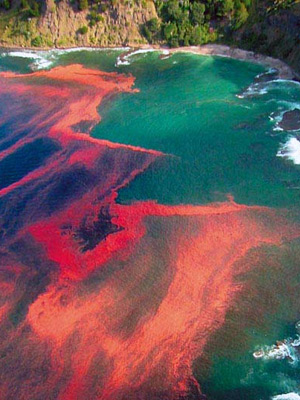
Adult Silt Striders hold such a distinctive name because they stride across silt - so one would believe them to be at least semi-aquatic in their adult form. Perhaps they are filter feeders, consuming phytoplankton as they wade through the swamps of the Bitter Coast - and perhaps they can also filter bugs and microbes from the ash stirred up in the Storms of the ashlands.
In the ashlands of Vvardenfell, one could find Silt Strider graveyards, not unsimilar to the elephant graveyards of Africa. These massive corpses - so far from the silt for which these creatures are named? Why would that be? It may be intentional.
Perhaps Silt Striders are like salmon, leaving their hatcheries to spend life far away, returning to the ash of their birth to mate and die. The eggs, upon hatching, could use the nutrient-rich husks of the adults for sustenance and shelter in the harsh landscape of the Ashlands until they're ready to pupate in their nigh-indestructible cocoons (as per lore). Eventually, upon emerging from these cocoons, they would make the trek back across the West Gash to the coastlines to live out their lives, until they are compelled to return to the Ashlands and start the cycle anew.
Raising young in what is, on the surface, a harsh environment is not unheard of in nature. Before giving birth, humpback whale mothers will often leave the nutrient-rich cold waters of the poles to nutrient-poor warm-water inlets. Here the mother fasts while her calf nurses. In such environments, there is not commonly enough nutrition to maintain populations of large predators, so the calf is well protected. When the calf is stronger, calf and mother move out of the inlet to more bountiful seas.
I would like to see the different forms of Silt Strider reflect their stage in the lifecycle. Adults, 'lobotomized domestic' and 'wild' around the Bitter Coast, Silt Strider eggs adhered to the underbellies of recently dead Silt Striders in the ashlands, nymphs within the corpses, or buried in the surrounding ash, indestructible larvae (just landscape objects - like rocks, no animations needed, perhaps?) and a juvenile 'molting' Silt Strider found throughout the western ashlands, West Gash, and Bitter Coast down to the Ascadian Isles.

![[External image]](http://tesrenewal.com/sites/all/modules/ckeditor/ckeditor/plugins/smiley/images/wink_smile.gif)
![[External image]](http://www.rosemaryjacobs.com/pre_dermabrasion_half.jpg)

![[External image]](http://naturallyearthfriendly.com/wp-content/uploads/2009/08/bioluminescence_lead.jpg)
![[External image]](http://1.bp.blogspot.com/_C97NrIblNPQ/TCZ2C1HN2nI/AAAAAAAABFw/9PhndWMZDmQ/s640/BioluminescenceClass.jpg)
![[External image]](http://37.media.tumblr.com/6afadd4c9337cfc430b7db58eafc69fe/tumblr_mpher0iEtQ1r6qglpo1_500.jpg)
![[External image]](http://i.imgur.com/lIjtz7Y.png)
![[External image]](http://tesrenewal.com/sites/all/modules/ckeditor/ckeditor/plugins/smiley/images/thumbs_up.gif)
I really like this idea, if
I really like this idea, if people are willing to take on the extra work